Opening hours & practical information What is where? APP Guided tours Further Language Offers accessibility FAQ

Pictures of the atrocities

Several people, including soldiers, walk along a street strewn with rubble. Buildings with destroyed roofs stand behind them.
View of the destroyed garages at the Boelcke barracks subcamp, 11 April 1945.
Photo: Bryce C. Thornton (Mittelbau-Dora Memorial)

On the morning of 11 April 1945, US soldiers came across the destroyed buildings of the Boelcke barracks on the outskirts of Nordhausen. There, among the bodies of well over 1,000 concentration camp prisoners, they found around 250 survivors.

Pictures of the piles of corpses went around the world after the liberation, revealing to the public the extent of the National Socialist crimes in the concentration camps.

Numerous dead people lie on the ground in front of a severely damaged building. Groups of people stand among the rubble in the background.
1/3
The bodies of prisoners killed in the camp lined up in front of the destroyed garages at the Boelcke barracks, April 1945.
Photo: Bryce C. Thornton (Mittelbau-Dora Memorial)
 Soldiers walk along a road lined on both sides with the bodies of numerous dead people. A fence and damaged buildings stand to the right.
2/3
US soldiers shortly after the liberation at the former subcamp in the Boelcke barracks, April 1945.
Photo: Geza M. Szirony (private ownership Jim Szirony)
Numerous dead people lie in front of a destroyed hall. A fence and the exposed roof structure are visible in the background.
3/3
Bodies of concentration camp prisoners and forced laborers amidst the rubble of the Boelcke barracks, April 1945.
Photo: unknow (private ownership Rhonda R. Dorsett)

In January 1945, the SS had converted two vehicle halls at the barracks into a subcamp of the Mittelbau concentration camp, which was used to house sick and dying prisoners. These prisoners were largely left to their fate – around 3,000 of them died in just three months.

British air raids on 3 and 4 April 1945 hit the barracks hard. The pilots were unaware that it was a prisoner camp. Numerous prisoners were killed in the attacks, as the German guards had denied them access to the air raid shelters.
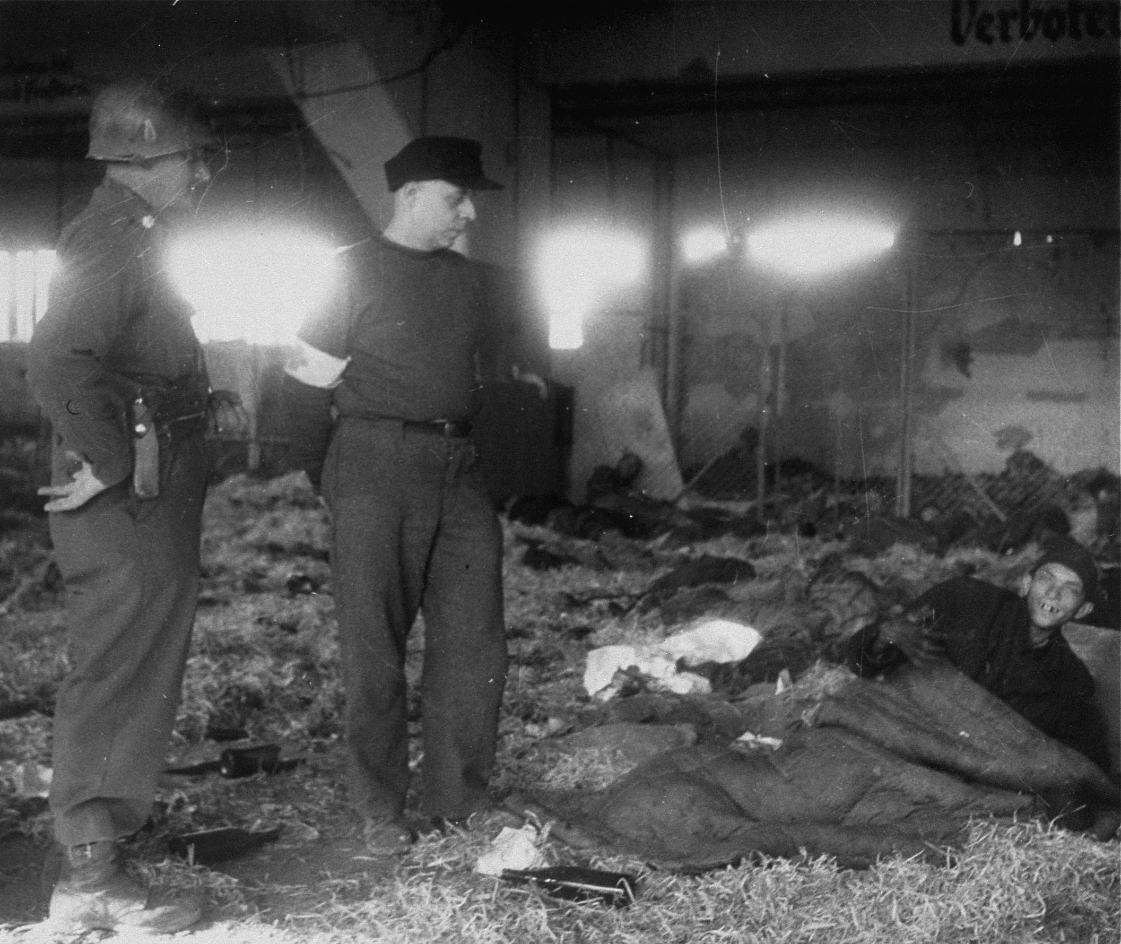
Two men, including a helmeted soldier, stand inside a damaged hall. On the right, a man lies on straw and blankets.
1/3
US Army medics providing medical care to survivors immediately after the liberation of the Boelcke barracks subcamp, 16 April 1945.
Photo: unknown (United States Holocaust Memorial Museum, Washington)
Two soldiers carry a person on a stretcher out of a damaged building. Other people stand near the entrance.
2/3
US Army medics providing medical care to survivors immediately after the liberation of the Boelcke barracks subcamp, 16 April 1945.
Photo: unknown (United States Holocaust Memorial Museum, Washington)
Two men are in an earthen trench among blankets, clothing and wooden planks. One lies in the foreground, while the other sits farther back.
3/3
Surviving concentration camp prisoners from the former subcamp in the Boelcke barracks setting up a makeshift shelter in a bomb crater, 11 April 1945.
Photo: Roberts / US Army Signal Corps (National Archives, Washington)

var _paq = window._paq = window._paq || []; /* tracker methods like "setCustomDimension" should be called before "trackPageView" */ _paq.push(['trackPageView']); _paq.push(['enableLinkTracking']); (function() { var u="https://matomo.buchenwald.de/"; _paq.push(['setTrackerUrl', u+'matomo.php']); _paq.push(['setSiteId', '13']); var d=document, g=d.createElement('script'), s=d.getElementsByTagName('script')[0]; g.async=true; g.src=u+'matomo.js'; s.parentNode.insertBefore(g,s); })();